Suburbia Contemporary, Spinnerei, Leipzig
Curated by Matteo Innocenti
Opening 13.09.25 – until 25.10.25
Around the beginning of the 2000s, the motivational slogan “Live Laugh Love” (the word order can be changed, if desired) circulated widely in various countries. Interestingly, like other similar mottos, this one also had an effect that was the opposite of its probable intentions: the message was trivialised by repetition, to the point of becoming meaningless. The phrase was used on posters, good luck charms, key rings, and every other imaginable gadget, as a way of encouraging people to enjoy the best that life has to offer. The very fact that the slogan became so well-known makes it legitimate to wonder what motivated people to appropriate it and give it visibility. One might speculate that we feel the need to insistently reify certain concepts when their meaning isn’t realised in reality. I believe that Anna Raczyńska’s ironic and clever play on words for the exhibition title, Live Laugh Labour, is a relevant response. The “intruder” term, labour, is truly the great presence of our time, so dominant that it diminishes the importance of everything else. Work and the economy frame individuals: they define roles and how we are perceived, they influence how we act and think, they serve as a measure for defining values, and, ultimately, they convince us of the need to remain continually active, according to specific norms, as if this alone were proof of the fact that we are alive. This has always been valid to a certain extent, it’s true, but since modernity, a new characteristic has emerged: the disconnect between our actions and the outcome. Labour is hard work that does not reveal its result; we could say it is almost a blind operation. The word, in this sense, fits into Anna Raczyńska’s line of research, which is marked by the dialectical relationship between the biographical and the social, the local and the global, the contingent and history. Through a process of semantic “subversion,” accompanied by the free use of a variety of techniques and materials (combining tradition and new technological possibilities), the artist investigates the problematic nature of some of the recurring symbols and meanings in contemporary society. Unlike the blind approach mentioned above, this is a creative process that combines analytical ability and sensitivity, encouraging the audience to reflect and interpret. This applies to all the works in the current exhibition, which has been conceived as a path of correspondences.
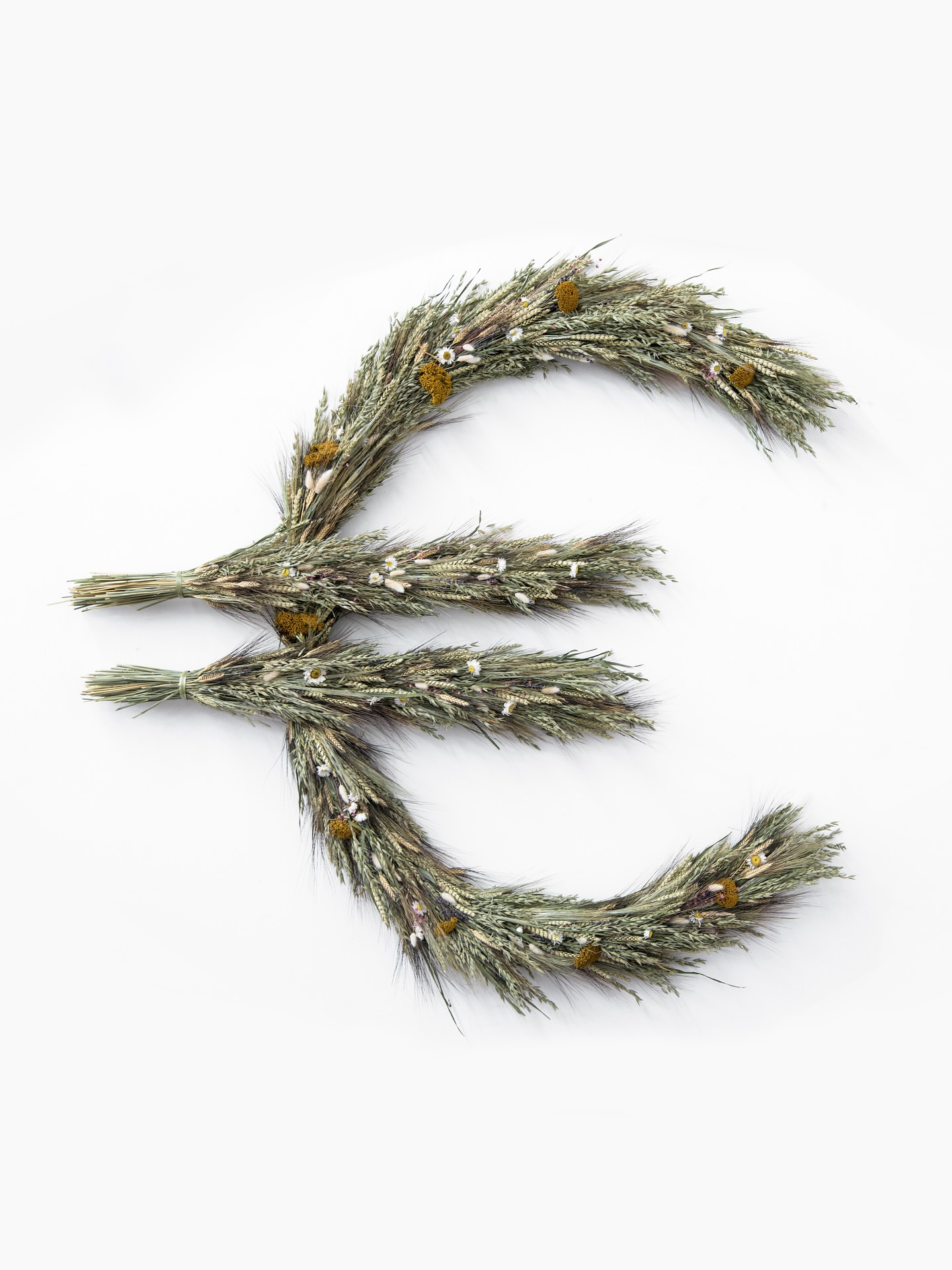
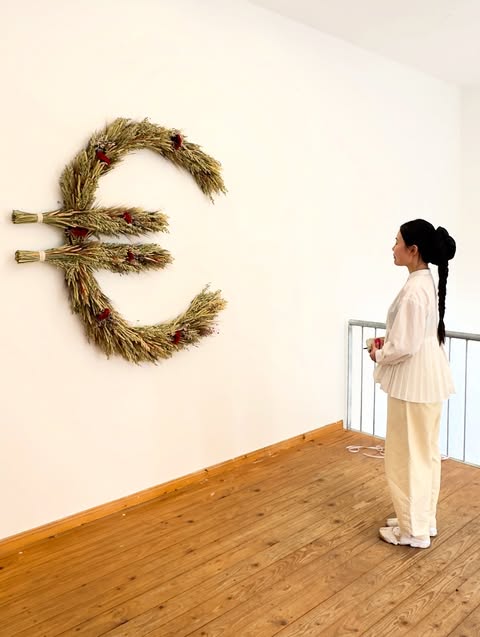
Future Primitive is a wreath of wheat and dried flowers, a reference to the prosperity of nature and rural harvest festivals. But its shape, reminiscent of the euro symbol, calls into question much more: Poland’s recent history, between its communist past and neoliberal orientation, the importance of wheat exports for the country, its membership of the European Union but not of the Economic and Monetary Union, and the growing tensions with Russia. We could say it addresses the complexity of relations between what we call the East and West of the continent.
The same symbol recurs, along with many others related to power and well-being, in Yesterday’s Tomorrow. There are three structures whose shape recalls Gothic windows, as well as the panels of a pictorial triptych – a reference to the common Christian roots of the West can be seen. They function as a diaphragm, beyond which a contemporary metropolis appears, represented through a myriad of signs that, in the current mindset, would have to do directly and indirectly with “good living”. The inspiration for the work came mainly from Hieronymus Bosch. In fact it could be seen as a “reinterpretation” of the Flemish master’s Garden of Earthly Delights, or as a translation into contemporary, earthly terms of Eden, Earth and Hell – bearing in mind that in our critical and disorienting age, the reign of financial capitalism, the three dimensions are blurred, and the comfort of the few is often the detriment of the many.
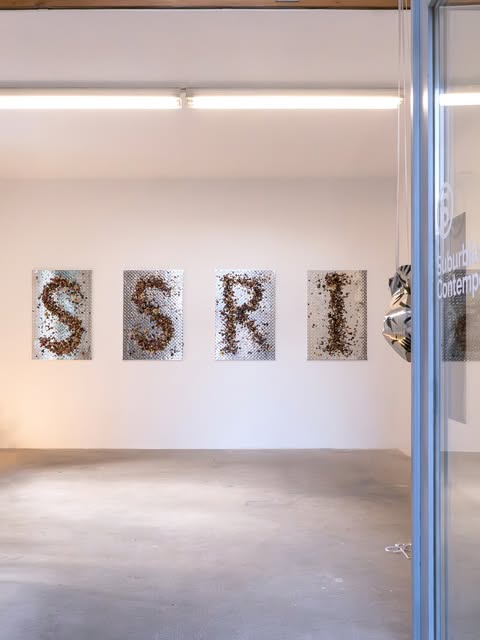
This damage is not only material but, with increasing frequency, also psychological. SSRI deals precisely with mental well-being and suffering (the acronym stands for “Selective Serotonin Reuptake Inhibitor” and refers to drugs used mainly as antidepressants). Four aluminium sheets, widely used for non-slip flooring, are arranged vertically, on each of them flowers form one of the letters of the title. The effect is surprising, as the sheets even appear to be wet. The contrast between the cold feel of the aluminium and the warm feel of the petals reflects the conflicting feelings experienced by the artist when spring arrived in Leipzig, when she felt uneasy inside but nevertheless continued to admire the strong life of nature and its blossoms.
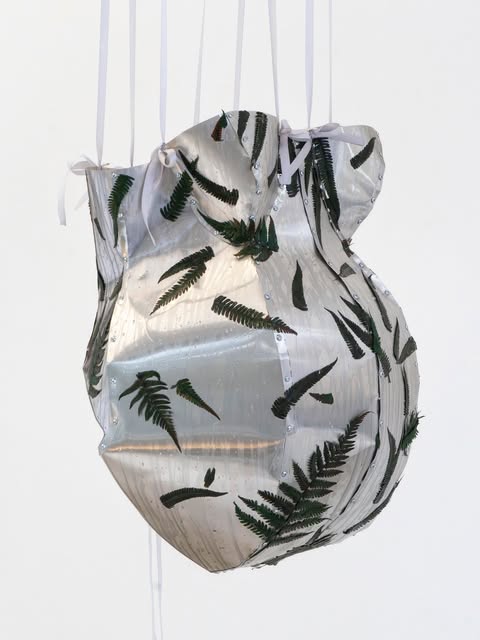
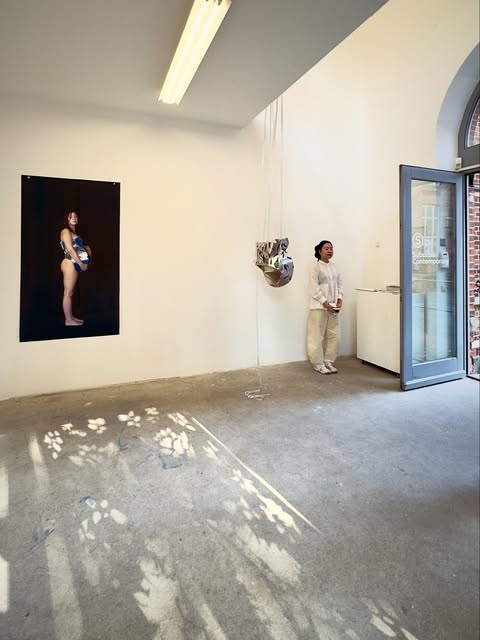
It seems to me that the exhibition has its ideal centre in the work in which the relationship between the self and the imagination occurs most compellingly; Soft Burden, Hard Shell: Bearing Weight Beyond the Body is a silhouette-armour suspended from above, derived from the artist’s torso. A self-portrait, in a sense, again with a modification, because the belly is that of a pregnant woman. Fertility, as well as being a biological fact, is present here as the ability to care for others. This is a further variation on the work, understood as carework, often associated with the female dimension. The iron armour and the womb appear to clash; I write “appear” because many dichotomies are a revisable legacy of the tradition of thought. This presence/absence calls into question various definitions: strength, weakness, endurance, and acceptance. And it seems to recall one of those “creative” identities that some of the leading post-human thinkers have been hypothesising for some time (think of Rosi Braidotti and Donna Haraway). Identities that, through variety and hybridisation, resist those conceptual restrictions which, although seemingly natural, are in fact historically determined and, very often, limiting.
Matteo Innocenti